
The system
SCHUFA is a private company owned by German banks, savings banks and retailers. It holds data on about 68 million people, roughly nine in ten German adults, and sells credit scores to around 9,000 businesses: banks, landlords, telecom and energy companies, shops. It answers about 140 million enquiries a year. In many German cities a SCHUFA certificate is in practice required to rent a flat.
In 2014 Germany’s Federal Court of Justice ruled that the scoring formula was a trade secret. People could see which data SCHUFA held about them, but not how it was weighted.
What happened
In 2018 the NGOs AlgorithmWatch and Open Knowledge Foundation Germany asked people to donate their SCHUFA records, and about 3,000 did. The analysis found that young men and people who moved often scored lower than others with similar records. It also found that no regulator had properly audited the model.
A person refused a loan because of their score took the case through a German court to the Court of Justice of the European Union. In December 2023 the Court ruled that when a lender relies heavily on such a score, producing the score counts as an automated decision under the GDPR, with the protections that come with it. In a parallel ruling it held that SCHUFA may not keep data on discharged debts longer than the public insolvency register does. Both rulings apply in all 27 EU member states. Neither forced SCHUFA to publish its formula.
On 17 March 2026 SCHUFA introduced a new score based on 12 published criteria, on a scale from 100 to 999. German consumer centres welcomed the added transparency. They also noted that only about a quarter of SCHUFA’s business partners used the new score at launch, and that older scores with undisclosed criteria were probably still in use.
Under the EU AI Act credit scoring is a high-risk use. After an amendment that came into force in July 2026, those rules apply from 2 December 2027.
What the record shows
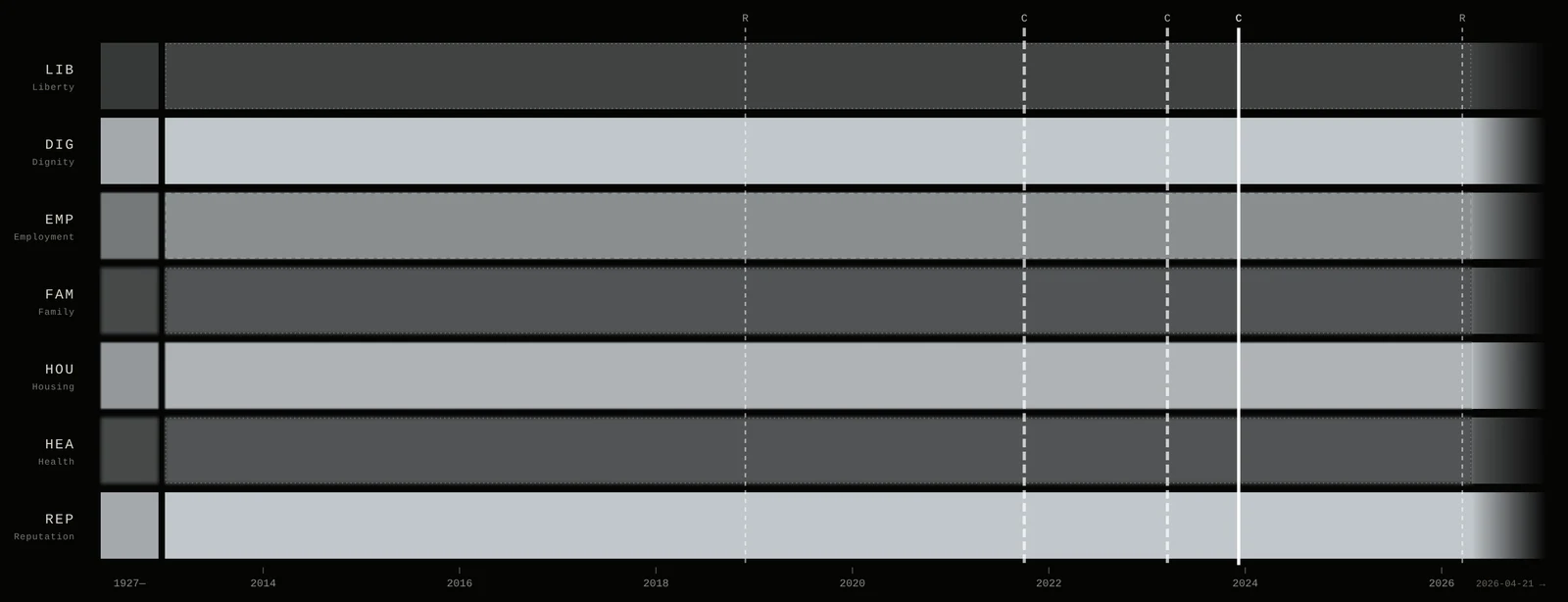
Three dimensions carry the weight, each at 8 of 10. Dignity: a person’s chances are decided by a score they cannot see into. Housing: the score controls access to renting. Reputation: the record follows people into every sector. Employment is at 6, family and health at 4 (real but weakly documented), and liberty at 2.
No point of no remedy is marked. The system runs continuously, and the record was coded before the 2026 reform could be assessed.
Reading the plate
The cold blue palette marks a gatekeeping system. The iris is dim and grainy because the model is still secret, so documentation is sparse. The red ring is sharp because the EU’s highest court has confirmed how the score shapes outcomes.
Key sources
- Court of Justice of the EU, C-634/21 OQ v Land Hessen, and joined cases C-26/22 and C-64/22 SCHUFA Holding, 7 December 2023
- Opinion of Advocate General Pikamäe, 16 March 2023
- Bundesgerichtshof, VI ZR 156/13, 28 January 2014
- AlgorithmWatch and Open Knowledge Foundation Germany, OpenSCHUFA, November 2018
- Verbraucherzentrale, “Neuer Schufa-Score: Die wichtigsten Infos”, 2026
The complete record for this case, with every source, the claims matrix and the coded data, is published in the open catalogue The Witnessed Sentence.