
The system
Since 2010 France’s national family-benefits fund (CNAF) has given every person receiving family, housing, disability or minimum-income benefits a risk score between 0 and 1. The score decides whom the 101 local benefit offices check first. The model is a logistic regression on about 40 variables, trained on the results of earlier checks. About 32 million people are scored each month, and about 600,000 checks a year are chosen by the score.
The model is designed to find overpayments, not fraud. The fund’s own 2018 report states that most overpayments it finds come from honest mistakes in declarations.
What happened
A ten-year study by the sociologist Vincent Dubois (2021) showed how the system concentrated checks on the most precarious people. In 2022 the French commission on access to administrative documents ordered the source code released. In November 2023 the digital-rights group La Quadrature du Net published the first public analysis of that code. Low income, single parenthood, disability benefits and living in a deprived neighbourhood all raised a person’s score. The data-protection authority issued findings that autumn but did not stop the system.
In October 2024 fifteen organisations, led by La Quadrature du Net and including Amnesty International France and the French Human Rights League, asked the Conseil d’État, France’s highest administrative court, to annul the system for indirect discrimination. The national ombudsperson, the Défenseure des droits, supported the case. In 2025 she found that the fund had not shown that its system did not discriminate. In January 2026 ten more organisations joined, and the fund published the code of its current model.
The fund’s own internal simulation, made public through the case, found that people on minimum income (13% of recipients) make up about 40% of the highest-scored 5%. Single mothers (14% of recipients) make up a similar share.
Where it stands
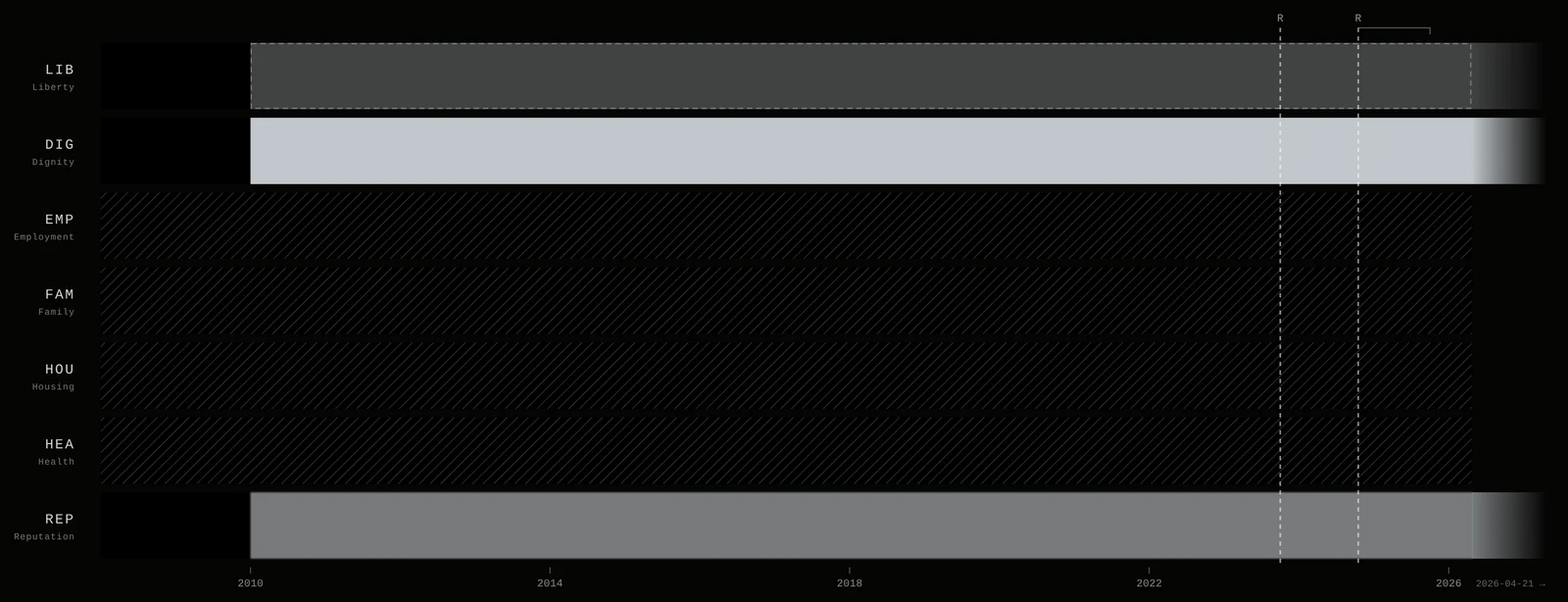
The system is still in use. When last checked, in October 2026, no decision from the Conseil d’État had been published. The record will be recoded after the court rules.
What the record shows
Dignity carries the heaviest documented harm (8): a whole population scored with stand-ins for poverty, disability and single motherhood. Reputation is at 5, since being selected for a check marks a person in their dealings with the state. Liberty is at 2, for population-wide exposure to scoring. Employment, family, housing and health are marked as insufficiently documented. Harm there is likely and appears in qualitative research, but it has not been measured.
No point of no remedy is marked while the case is open.
Reading the plate
The faint swirl in the pupil marks a statistical model followed by a human decision. The iris is dimmer than in SyRI or the Toeslagenaffaire: the record is strong, but there has been no parliamentary inquiry. The red point is at its largest size.
Key sources
- Vincent Dubois, Contrôler les assistés, Raisons d’Agir, 2021
- CADA, opinion 20226179, December 2022
- La Quadrature du Net, Notation des allocataires, November 2023, and analysis of the 2025 model, February 2026
- CNIL, délibération 2023-120
- Coalition application to the Conseil d’État, 16 October 2024; expansion to 25 organisations, January 2026
The complete record for this case, with every source, the claims matrix and the coded data, is published in the open catalogue The Witnessed Sentence.